
Wednesday, September 10, 2008
Ship
I painted this on my tablet PC. It's about the most artistic thing I've ever done. (Click for larger)


Monday, September 8, 2008
I am all that is man.
So I left class a little bit early today to race down to the Tour of Missouri, a high profile bicycle race that includes Olympic riders, Tour de France riders, etc. I missed the finish by a few minutes, which was a bit disappointing, but Alex and I still had a chance to walk around and look at some of the various bike vendors and merchandise kiosks they had up for the race.
One of the kiosks was sponsored by some Missouri Beef association, had some trainers set up, and you could get on and ride as hard as you could to see what your maximum power output per pound of body weight was. The hourly winner was supposed to get a T-shirt, and the daily winner was supposed to get $200 worth of beef products (steak, jerky, etc).
At this point, one of the spectators / drunken participants in the contest saw me with my Hapkeyer hat, rolled up jeans, and fixed gear, and the heckling began. "Did you deliver the mail yet, bike messenger?!....Show me your trackstand!!....We've gotta ringer here!!!"
Anyway, after having ridden 40 miles Saturday, I still figured I'd give it a go. My first try, I put out 1102 watts of power (for a power/weight ratio of 6.89 watts/lb). For comparison, a horsepower is 746 watts (with a power/weight ratio for .62 watts/lb (assuming a 1200 lb "light riding" horse [wikipedia])).
My 1102 watts set the hourly record in terms of absolute power output (independent of body size), and also the daily record for power/weight ratio (some other guy had put out 1210 watts earlier, but he must have been a bigger guy, as his ratio was only 4.4 watts/lb).
However, the people putting on the contest had apparently determined that the power/weight calculation was too difficult early in the day, and so were no longer calculating this ratio.... so I didn't get the $200 of beef (those bastards). But I did get a quick-dry wicking T-shirt that says "BEEF. It's what's for dinner" on it. And it did make me feel like a monster.
Rockin.
One of the kiosks was sponsored by some Missouri Beef association, had some trainers set up, and you could get on and ride as hard as you could to see what your maximum power output per pound of body weight was. The hourly winner was supposed to get a T-shirt, and the daily winner was supposed to get $200 worth of beef products (steak, jerky, etc).
At this point, one of the spectators / drunken participants in the contest saw me with my Hapkeyer hat, rolled up jeans, and fixed gear, and the heckling began. "Did you deliver the mail yet, bike messenger?!....Show me your trackstand!!....We've gotta ringer here!!!"
Anyway, after having ridden 40 miles Saturday, I still figured I'd give it a go. My first try, I put out 1102 watts of power (for a power/weight ratio of 6.89 watts/lb). For comparison, a horsepower is 746 watts (with a power/weight ratio for .62 watts/lb (assuming a 1200 lb "light riding" horse [wikipedia])).
My 1102 watts set the hourly record in terms of absolute power output (independent of body size), and also the daily record for power/weight ratio (some other guy had put out 1210 watts earlier, but he must have been a bigger guy, as his ratio was only 4.4 watts/lb).
However, the people putting on the contest had apparently determined that the power/weight calculation was too difficult early in the day, and so were no longer calculating this ratio.... so I didn't get the $200 of beef (those bastards). But I did get a quick-dry wicking T-shirt that says "BEEF. It's what's for dinner" on it. And it did make me feel like a monster.
Rockin.
This weekend...
...I rode 40 miles on a fixed gear
...I lost feeling in my junk (see above for reason)
...I resolved to get a new saddle (see above for reason)
...I was loaned a new saddle for free ninety nine
...I fished
...I camped
...I ran some trails
...I jumped from rock to rock across creeks
...I got sunburned
...I got attacked by fire ants
...I didn't get a mountain bike, but have now fully resolved to. SS of some sort for the fall is the goal.
For some reason, I'm tired.
...I lost feeling in my junk (see above for reason)
...I resolved to get a new saddle (see above for reason)
...I was loaned a new saddle for free ninety nine
...I fished
...I camped
...I ran some trails
...I jumped from rock to rock across creeks
...I got sunburned
...I got attacked by fire ants
...I didn't get a mountain bike, but have now fully resolved to. SS of some sort for the fall is the goal.
For some reason, I'm tired.
Wednesday, September 3, 2008
YES!
So Google's Personalized Homepage (iGoogle) feature was pretty awesome... until they subjected some of us to an "experimental" new version of the homepage layout.. and there was nothing we could do to opt out of this experiment. It was very frustrating, as the new interface was particularly buggy and counterintuitive. It was even more frustrating that some people didn't have to deal with this crap! (Eg, Naomi still had the old iGoogle, while I had the sucky one).
Anyway, I found this online at a Google Group page: a way to revert back to the old iGoogle!
Here are the instructions:
Anyway, I found this online at a Google Group page: a way to revert back to the old iGoogle!
Here are the instructions:
Go to "http://www.google.com/ig/settings"
Go to the bottom of the page, export your settings. Save it some
where offline.
Go to the "reset" iGoogle page "http://www.google.com/ig/resetprefs.html"
select "Reset all preferences"
Go back to "http://www.google.com/ig/settings"
Go to the bottom of the page, import the export from previous steps.
Back to non-Experimental iGoogle.
It works perfectly. Awesome.Tuesday, September 2, 2008
New Cycling Cap!
My custom hat from Spokepunchers.com just arrived. I'm really happy with it. There's a central orange stripe down the middle of it, front to back, that didn't show up due to the angle of the pictures.


Sunday, August 31, 2008

Thursday, August 28, 2008
New Kicks
I never get excited about shoes.... except these ones.
Senior year I picked up a pair of Converse, and they were the greatest shoes ever. It was only when I went to buy another identical pair that I realized that they must've been a special edition, because I couldn't find them. I recently discovered a similar pair in a store nearby, but they were a hideous color, and not my size. But, I did learn their name, so I found them online.
They are the perfect shoe.

Oh jesh.
Senior year I picked up a pair of Converse, and they were the greatest shoes ever. It was only when I went to buy another identical pair that I realized that they must've been a special edition, because I couldn't find them. I recently discovered a similar pair in a store nearby, but they were a hideous color, and not my size. But, I did learn their name, so I found them online.
They are the perfect shoe.

Oh jesh.
Ehlers-Danlos?
So I wonder if I have a mild case of Ehler's Danlos. Here are medical pictures of individuals diagnosed with it.


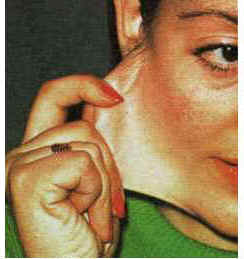
Here is me.


Possible, I think.
Here is me.


Possible, I think.
Saturday, August 23, 2008
seeqpod playlist
i just built up this seeqpod playlist. haven't listened to it yet, but it might be promising. warning: profanity.
SeeqPod - Playable Search
SeeqPod - Playable Search
Friday, August 22, 2008
Another Bug Post
Pictures of some bugs we caught around my house that I mounted (click for larger images):
My favorite: A female cicada killer mounted along with a cicada. That is how they carry the cicadas once they've paralyzed them with an injection from that massive stinger. (For proof of that, see a previous post here).
 Kinda interesting (and it was challenging / fun to pin): Huge locust / grasshopper. Picture of it along with the other pair is for scale, and another angle.


My favorite: A female cicada killer mounted along with a cicada. That is how they carry the cicadas once they've paralyzed them with an injection from that massive stinger. (For proof of that, see a previous post here).
 Kinda interesting (and it was challenging / fun to pin): Huge locust / grasshopper. Picture of it along with the other pair is for scale, and another angle.

Monday, August 18, 2008
Saturday, August 16, 2008
Cicada-killer
So I've had an infestation of these huge hornets near my house recently. My dad, seeing them, said he thought they were the kinda that killed cicadas, and laid their eggs in them.
Well today, at a garage sale on a close by street, I saw this behavior in action.
AWESOME.
The female had already caught and paralyzed the cicada, and was stinging it over and over, then carrying it off to her nest.
See the bottom of this post for detailed info; short and sweet facts here:
-Females are the only ones that can sting, and rarely sting humans. If they do, it might only feel like a pinprick.
-Males will fight with one another, but can't harm humans.
-The males don't stray more than 60 ft. from where they hatch, but can find their way home from 6 miles away.
-The females catch both male and female cicadas... impressive because the female cicadas don't sing like the males do.
-The females always lay their eggs under one of two specific legs on the cicada, to provide better access for the feeding grub into the juicy parts.
Pictures:


From wikipedia:
After digging a nest chamber in the burrow, female cicada killers capture cicadas, paralyzing them with a sting; the cicadas then serve as food to rear their young. After paralyzing a cicada, the female wasp straddles it and takes off toward her burrow; this return flight to the burrow is difficult for the wasp because the cicada is often more than twice her weight. After putting the cicada in the nest cell, the female deposits an egg on the cicada and closes the cell with dirt. Male eggs are laid on a single cicada but female eggs are given two or sometimes three cicadas; this is because the female wasp is twice as large as the male and must have more food. New nest cells are dug as necessary off the main burrow tunnel and a single burrow may eventually have 10 to 20 cells. The egg hatches in one or two days, and the cicadas serve as food for the grub. The larvae complete their development in about 2 weeks. Overwintering occurs as a mature larva within an earth-coated cocoon. Pupation occurs in the nest cell in the spring and lasts 25 to 30 days. There is only one generation per year and no adults overwinter.
The males are more often seen in groups, vigorously challenging one another for position on the breeding aggregation from which they emerged, and generally pursuing anything that moves or flies within close proximity. It is not unusual to see two or three male wasps locked together in midair combat, the aggregate adopting an erratic and uncontrolled flight path until one of the wasps breaks away. The male wasp's aggressive behavior is extremely similar to that of another robust insect of the area, the male carpenter bee. In both cases, while the males' vigorous territorial defense can be extremely frightening and intimidating to human passersby, the males pose no danger whatsoever. They will only grapple with other insects, and cannot sting.
While they may be frightfully large[2], female cicada killer wasps are not aggressive and rarely sting unless they are grasped roughly, stepped upon with bare feet, or caught in clothing, etc. One author who has been stung indicates that for them, the stings are not much more than a "pinprick"[3]. Males aggressively defend their perching areas on nesting sites against rival males but they have no sting. Although they appear to attack anything which moves near their territories, male cicada killers are actually investigating anything which might be a female cicada killer ready to mate. Such close inspection appears to many people to be an attack, but the wasps rarely even land on people. If handled roughly females will sting, and males will jab with a sharp spine on the tip of their abdomen. Both sexes appear to be well equipped to bite, as they have large jaws; however, they are unable to grasp human skin and cannot bite. They are non-aggressive towards humans and fly away when swatted at, instead of attacking. Cicada killers exert a natural control on cicada populations and thus may directly benefit the deciduous trees upon which cicadas feed.
From http://ww2.lafayette.edu/~hollidac/bigwasp.html:
Using tagged wasps, I have learned that males rarely move more than 20 meters from their home ranges and that they will return there when captured and released up to two kilometers away. Thus, it is clear that, although they patrol for potential mates in only one area, they know the surrounding area very well, probably from feeding forays.
Female cicada-killers always lay their 4-5 mm long eggs under the left or right second leg of the cicada, presumably because it puts the emerging wasp larva in the best position to begin eating the cicada. As noted by Fabre, insects paralyzed by hunting wasps continue to live and they stay "fresh" (that is, mold-free) much longer than if they are dead.
Picture Credits:
Wikipedia, http://ww2.lafayette.edu/~hollidac/bigwasp.html
Well today, at a garage sale on a close by street, I saw this behavior in action.
AWESOME.
The female had already caught and paralyzed the cicada, and was stinging it over and over, then carrying it off to her nest.
See the bottom of this post for detailed info; short and sweet facts here:
-Females are the only ones that can sting, and rarely sting humans. If they do, it might only feel like a pinprick.
-Males will fight with one another, but can't harm humans.
-The males don't stray more than 60 ft. from where they hatch, but can find their way home from 6 miles away.
-The females catch both male and female cicadas... impressive because the female cicadas don't sing like the males do.
-The females always lay their eggs under one of two specific legs on the cicada, to provide better access for the feeding grub into the juicy parts.
Pictures:
From wikipedia:
After digging a nest chamber in the burrow, female cicada killers capture cicadas, paralyzing them with a sting; the cicadas then serve as food to rear their young. After paralyzing a cicada, the female wasp straddles it and takes off toward her burrow; this return flight to the burrow is difficult for the wasp because the cicada is often more than twice her weight. After putting the cicada in the nest cell, the female deposits an egg on the cicada and closes the cell with dirt. Male eggs are laid on a single cicada but female eggs are given two or sometimes three cicadas; this is because the female wasp is twice as large as the male and must have more food. New nest cells are dug as necessary off the main burrow tunnel and a single burrow may eventually have 10 to 20 cells. The egg hatches in one or two days, and the cicadas serve as food for the grub. The larvae complete their development in about 2 weeks. Overwintering occurs as a mature larva within an earth-coated cocoon. Pupation occurs in the nest cell in the spring and lasts 25 to 30 days. There is only one generation per year and no adults overwinter.
The males are more often seen in groups, vigorously challenging one another for position on the breeding aggregation from which they emerged, and generally pursuing anything that moves or flies within close proximity. It is not unusual to see two or three male wasps locked together in midair combat, the aggregate adopting an erratic and uncontrolled flight path until one of the wasps breaks away. The male wasp's aggressive behavior is extremely similar to that of another robust insect of the area, the male carpenter bee. In both cases, while the males' vigorous territorial defense can be extremely frightening and intimidating to human passersby, the males pose no danger whatsoever. They will only grapple with other insects, and cannot sting.
While they may be frightfully large[2], female cicada killer wasps are not aggressive and rarely sting unless they are grasped roughly, stepped upon with bare feet, or caught in clothing, etc. One author who has been stung indicates that for them, the stings are not much more than a "pinprick"[3]. Males aggressively defend their perching areas on nesting sites against rival males but they have no sting. Although they appear to attack anything which moves near their territories, male cicada killers are actually investigating anything which might be a female cicada killer ready to mate. Such close inspection appears to many people to be an attack, but the wasps rarely even land on people. If handled roughly females will sting, and males will jab with a sharp spine on the tip of their abdomen. Both sexes appear to be well equipped to bite, as they have large jaws; however, they are unable to grasp human skin and cannot bite. They are non-aggressive towards humans and fly away when swatted at, instead of attacking. Cicada killers exert a natural control on cicada populations and thus may directly benefit the deciduous trees upon which cicadas feed.
From http://ww2.lafayette.edu/~hollidac/bigwasp.html:
Using tagged wasps, I have learned that males rarely move more than 20 meters from their home ranges and that they will return there when captured and released up to two kilometers away. Thus, it is clear that, although they patrol for potential mates in only one area, they know the surrounding area very well, probably from feeding forays.
Female cicada-killers always lay their 4-5 mm long eggs under the left or right second leg of the cicada, presumably because it puts the emerging wasp larva in the best position to begin eating the cicada. As noted by Fabre, insects paralyzed by hunting wasps continue to live and they stay "fresh" (that is, mold-free) much longer than if they are dead.
Picture Credits:
Wikipedia, http://ww2.lafayette.edu/~hollidac/bigwasp.html
Thursday, August 14, 2008
.png)
.png)
Subscribe to:
Posts (Atom)